
How Yacht Crew Management Software Supports Crews
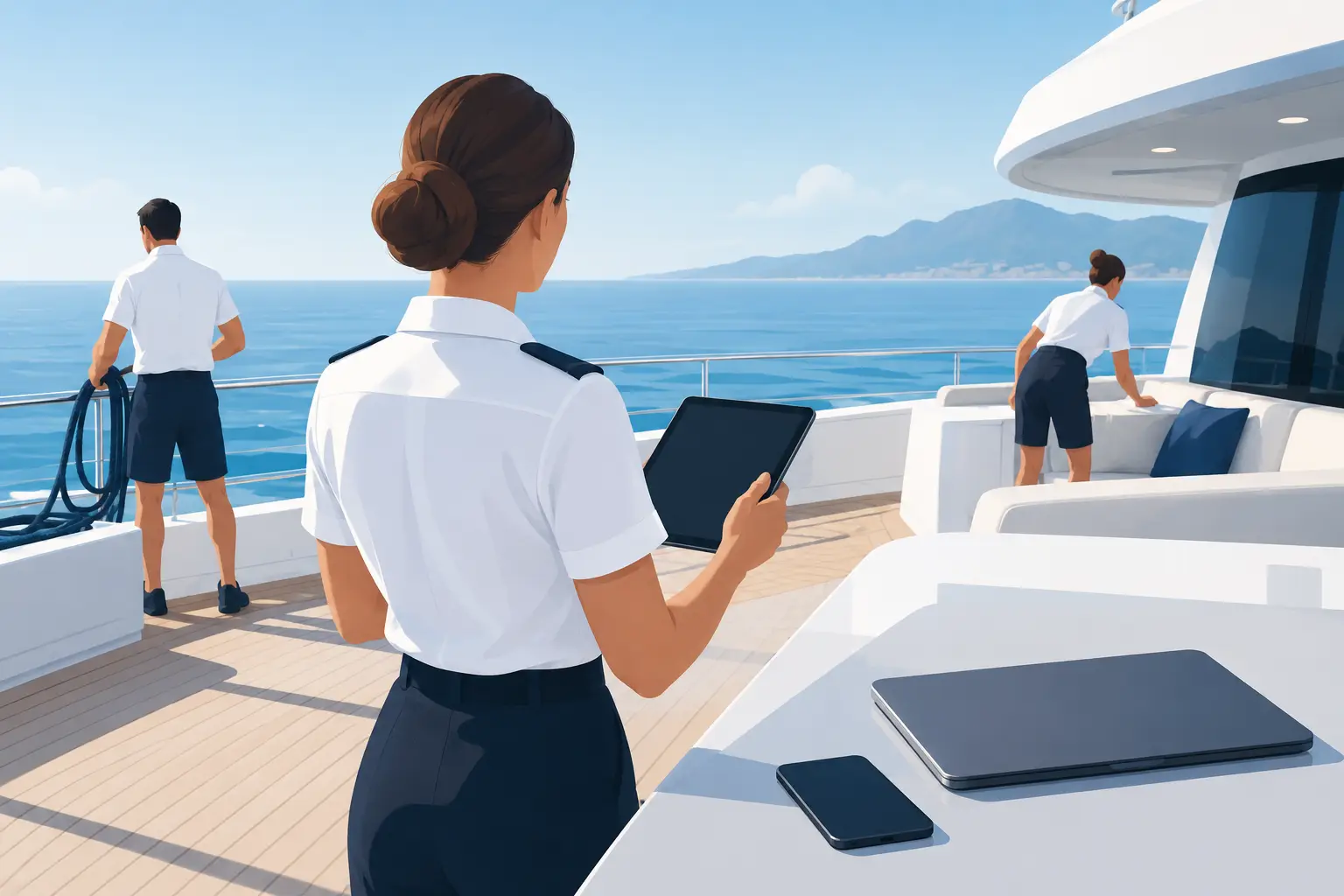
A crew change can affect far more than a single cabin assignment. It changes who holds responsibility, where key crew records sit, and how quickly a captain or department head can confirm the current position. Yacht crew management software brings order to that moving operational picture without forcing crew administration into the same process as maintenance, cash, or guest provisioning.
For a professional yacht, crew administration is a distinct workstream. It needs clear ownership, current records, and access where work is happening - on a phone, tablet, or computer browser. When those basics are handled well, the wider vessel operation becomes easier to manage.
What yacht crew management software should do
The purpose is not to turn a yacht into a generic office. It is to give the people responsible for crew administration a focused place to manage the information that supports daily operation.
A practical system should make current crew information easier to locate and maintain. Captains need a reliable operational view. Department heads need clarity around the people working within their area. Yacht managers and owners' representatives need confidence that crew administration is organized rather than dispersed across spreadsheets, inboxes, and individual devices.
That does not mean every person needs access to every record. Crew information should be structured according to responsibility. The captain, purser, chief officer, and department heads may require different views of the same operation. Good software supports those responsibilities without creating unnecessary complexity.
Browser-based access matters here. Crew work does not remain at a desk. A change may need to be checked during a handover, updated in a crew area, or reviewed while moving between departments. Software that works in a browser on phones and tablets keeps the administrative tool close to the operation it supports.
Crew administration is part of the operating system
Crew management is often treated as a separate administrative task until a change exposes a gap. A missing update, an outdated document folder, or uncertainty over who is currently responsible can slow a handover and create avoidable follow-up work.
The better approach is to recognize crew administration as one component of the yacht's operating system. It sits alongside bridge and deck logs, maintenance records, wine cellar inventory, cash book activity, and refit project tracking. Each discipline has its own requirements. Each benefits from a dedicated workflow.
This distinction is important. A chief engineer should not have to work around a crew-focused interface to maintain engineering records. A chief stew should not need to adapt a maintenance system to track the cellar. Equally, the person administering crew should not have to force personnel work into a generic project board.
Focused applications reduce that compromise. They give departments a tool built around the work they actually do, while supporting a more orderly vessel operation overall.
Where manual crew processes begin to fail
Spreadsheets and shared folders can be useful, particularly on a smaller operation or during a short period of stability. They are familiar, flexible, and easy to start. The issue is not that they are always wrong. The issue is that they depend on consistent manual control.
As personnel change, files multiply and ownership becomes less clear. One version may be saved on a laptop, another may sit in an email thread, and a third may have been updated by a different department. Finding the current record then becomes a search task rather than a simple operational check.
Manual processes also create a handover risk. The outgoing person may know exactly where information sits. Their replacement may not. A system designed for crew administration provides a defined place for the work, reducing reliance on individual memory and personal filing habits.
There is a trade-off. Moving from familiar documents to dedicated software requires a team to adopt a common process. If the workflow is too broad, too technical, or poorly matched to onboard responsibilities, adoption will be weak. The best choice is not the system with the longest feature list. It is the one crew can use consistently because it reflects how the yacht is run.
How to assess the right platform
Start with responsibility, not software labels. Identify who owns crew administration and what they need to see, update, and hand over. Then consider how that work connects to the wider operation without losing its departmental focus.
A useful platform should answer practical questions quickly. Can the responsible person find current crew information without searching through multiple files? Can the work be accessed in a browser on the devices used onboard? Is the interface clear enough that a new crew member can understand where their responsibility begins? Does the system preserve a disciplined structure as people and roles change?
It should also fit alongside the yacht's other working records. A vessel is not managed through crew data alone. Bridge and deck activity, maintenance, inventory, onboard cash, and refit planning all create their own stream of information. When each department relies on disconnected tools, leaders spend time reconciling rather than managing.
A unified suite can address that problem without pretending that every department works in the same way. The value is not one oversized application for every task. It is a connected set of focused applications, each aligned with a real onboard responsibility.
A focused approach for each department
SuperyachtApps follows this departmental model. CrewDeck supports crew administration, while BridgeDeck is designed for bridge and deck logs, EngineDeck for maintenance records, CellarDeck for wine cellar inventory, CashDeck for the cash book, and RefitDeck for refit project tracking.
The distinction is operationally useful. It gives each department a purpose-built place to work, rather than asking crew to reshape their process around a generic business system. The applications are browser-based, supporting use on phones and tablets as well as computers.
For captains and operational decision-makers, this structure helps clarify accountability. Crew administration stays with the people responsible for it. Engineering records remain with the engineering function. Refit activity has its own project environment. The yacht gains a more organized working picture without blurring departmental ownership.
Build discipline into the handover
The strongest use of crew management software is not occasional administration. It is consistent operational discipline. Information should be reviewed and maintained as part of normal work, not reconstructed when a handover or management request makes it urgent.
This is where clarity matters more than complexity. Establish who maintains crew information, when it is reviewed, and how changes are communicated internally. Keep the process proportionate to the yacht's operation. A tightly run vessel does not need extra steps for their own sake. It needs a dependable routine that people can follow.
Captains can set the expectation. Department heads can keep their own responsibilities current. Pursers and crew administrators can maintain the structured record. Yacht managers can assess whether the information is organized and accessible rather than dependent on one individual's inbox or device.
A digital system supports that discipline, but it does not create it on its own. The operational gain comes from assigning ownership and using the same place for the same work every time.
Choose clarity over complexity
Yacht crew management software is most valuable when it makes the responsible person's next action obvious. It should reduce time spent locating information, strengthen continuity through crew changes, and give decision-makers a clearer view of the active operation.
The right approach depends on the yacht's size, crew structure, and management model. But the principle remains consistent: crew administration deserves a dedicated operational tool, not an improvised collection of files. Put the responsibility in a clear system, keep it current, and let the crew focus on running the vessel.